Maths basics
How to Calculate Percentage Increase and Decrease (and the 20% Trap)
Work out percentage increase and decrease in three steps, see why a 20% rise followed by a 20% fall does not bring you back, and avoid common mistakes.
Your rent went from ₹12,000 to ₹15,000. Your phone plan dropped from ₹499 to ₹399. Shares you bought rose, then fell. In each case the question is the same: by what percentage did it change? There is one formula for all of them, and one trap that catches almost everyone at least once.
The three-step method
- Find the difference: new value − old value.
- Divide by the old value.
- Multiply by 100.
% change = (new − old) ÷ old × 100
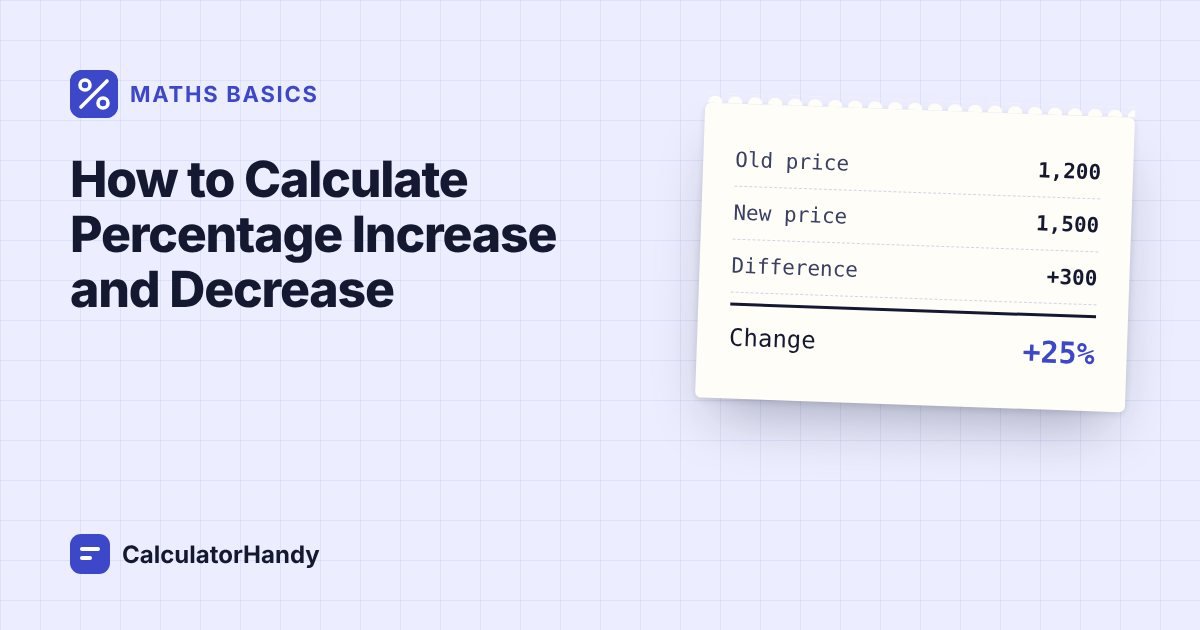
Rent from ₹1,200 to ₹1,500 (or ₹12,000 to ₹15,000, the maths is identical): 1,500 − 1,200 = 300, then 300 ÷ 1,200 = 0.25, then × 100 = 25% increase.
Decreases work the same way
A price falling from 1,500 to 1,200: 1,200 − 1,500 = −300, and −300 ÷ 1,500 = −0.2, so the change is −20%, a 20% decrease.
Notice something odd. Going up from 1,200 to 1,500 was 25%, but coming back down the same 300 is only 20%. The gap is the same; the starting point is not. Percentages always depend on what you divide by.
The 20% trap
Suppose something worth 1,000 rises 20% and then falls 20%. Many people expect to end at 1,000. Here is what actually happens:
- Up 20%: 1,000 × 1.2 = 1,200
- Down 20% from there: 1,200 × 0.8 = 960
You end 4% lower than you started, because the fall was taken from the bigger number. This matters for investments: a fund that loses 50% needs to gain 100%, not 50%, just to get back to where it was.
Increasing or reducing by a percentage
Sometimes you know the percentage and want the new number. Multiply by (1 + rate) to increase, or (1 − rate) to decrease:
| Task | Shortcut | Example |
|---|---|---|
| Add 20% | × 1.20 | 1,000 → 1,200 |
| Remove 20% | × 0.80 | 1,200 → 960 |
| Add 5% | × 1.05 | 1,000 → 1,050 |
| Remove 12.5% | × 0.875 | 800 → 700 |
Percentage points are not percentages
If a bank raises its interest rate from 8% to 9%, the rate went up by 1 percentage point, but by 12.5% in relative terms (1 ÷ 8). News reports mix these up often. When the numbers being compared are themselves percentages, say which one you mean.
Quick checks that catch mistakes
- If the new value is bigger, the answer must be positive. If you get a negative, you probably subtracted the wrong way round.
- A decrease can never be more than 100%. An increase can: going from 100 to 350 is a 250% increase.
- Always divide by the old value, unless you are deliberately working backwards from a final figure.
For growth over several years, a single percentage change hides how fast things grew each year. The CAGR Calculator turns a start and end value into a yearly rate.
Frequently asked questions
What is the formula for percentage change?
Subtract the old value from the new value, divide the result by the old value, and multiply by 100. A positive answer is an increase and a negative one is a decrease.
Is percentage change the same as percentage difference?
No. Percentage change measures movement from a starting value. Percentage difference compares two values without either being the starting point, so it divides by their average instead.
Why do my salary hike and the price rise not cancel out?
Because each percentage is taken from a different base. A 10% raise on ₹50,000 is ₹5,000, while 10% inflation on your ₹30,000 of spending is ₹3,000. Compare the amounts, not just the percentages.