Shopping
Why 20% + 10% Off Is Not 30% Off: Stacked Discounts Explained
Learn how stacked discounts really work, why 20% then 10% off equals 28%, how to compare sale offers, and how to work out the real percentage off any price.
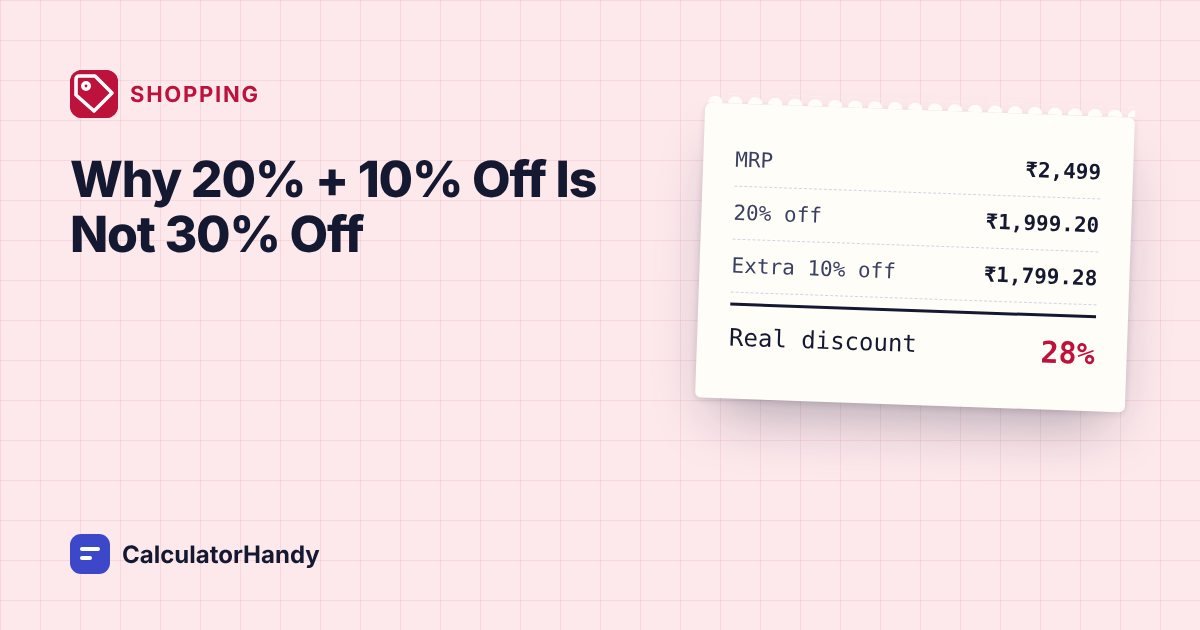
The banner says “20% off + extra 10% off”. Most of us read that as 30% off. It isn’t, and during big online sales that small difference adds up across a cart. Here is exactly how stacked discounts work.
Discounts multiply, they don’t add
The second discount is applied to the price after the first one, not to the original price.
A jacket with an MRP of ₹2,499:
- 20% off: 2,499 × 0.80 = ₹1,999.20
- Extra 10% off: 1,999.20 × 0.90 = ₹1,799.28
You save ₹699.72, which is 28% of ₹2,499, not 30%. A straight 30% off would have brought the price down to ₹1,749.30, about ₹50 less.
The quick formula
Combined discount = 1 − (1 − d₁) × (1 − d₂)
For 20% and 10%: 1 − 0.8 × 0.9 = 1 − 0.72 = 0.28, or 28%. Some common combinations:
| Offer | Real discount |
|---|---|
| 10% + 10% | 19% |
| 20% + 10% | 28% |
| 30% + 20% | 44% |
| 50% + 20% | 60% |
| 50% + 50% | 75% |
Working out the real “% off” from two prices
Shops often show the MRP and a sale price but not the percentage, or round it generously. Divide the saving by the original price:
MRP ₹2,499, sale price ₹1,999: saving ₹500, and 500 ÷ 2,499 = 20.01% off. If the tag says “25% off”, the maths says otherwise.
Comparing two different offers
- Flat ₹500 off vs 15% off: on a ₹2,999 item, 15% is ₹449.85, so the flat ₹500 is better. On a ₹4,000 item, 15% is ₹600, so the percentage wins. The crossover is where 15% of the price equals ₹500: about ₹3,333.
- Bank offer caps: “10% off up to ₹1,500” stops growing once 10% reaches ₹1,500, at a ₹15,000 cart. Spending more earns no more discount.
- Buy 2, get 1 free: that is a 33.3% discount on three items, but only if you wanted all three.
A shopper’s checklist
- Compare the final payable amount at checkout, after coupons, delivery charges and any convenience fee.
- Check whether the “original” price was actually charged recently; inflated MRPs make discounts look bigger.
- Calculate cashback separately and only count it once it is in your account.
Frequently asked questions
Does the order of discounts matter?
No. 20% then 10% gives the same final price as 10% then 20%, because multiplication works in any order. What matters is whether the second discount is taken from the reduced price, which it almost always is.
Is a coupon applied before or after GST?
Usually before. GST is charged on the price after the discount shown on the invoice. Check the final checkout total to be sure.
Is cashback the same as a discount?
Not quite. Cashback arrives later, often with conditions, and the price you pay up front stays the same. Compare offers on the amount you finally pay after any cashback is credited.