Health
Ideal Weight for Your Height: What the Four Formulas Say
How the Devine, Robinson, Miller and Hamwi formulas estimate ideal body weight, worked examples for men and women, and why a healthy range matters more.
“What should I weigh?” sounds like it should have a single answer. It doesn’t. What exists instead is a handful of formulas, each designed decades ago for a specific job, which happen to give similar but not identical answers. Knowing where they came from makes them far more useful.
The four formulas
All four start at 5 feet (152.4 cm) and add a fixed amount for every inch above that:
| Formula (year) | Men | Women |
|---|---|---|
| Devine (1974) | 50 kg + 2.3 kg per inch | 45.5 kg + 2.3 kg per inch |
| Robinson (1983) | 52 kg + 1.9 kg per inch | 49 kg + 1.7 kg per inch |
| Miller (1983) | 56.2 kg + 1.41 kg per inch | 53.1 kg + 1.36 kg per inch |
| Hamwi (1964) | 48 kg + 2.7 kg per inch | 45.5 kg + 2.2 kg per inch |
Devine’s formula was created to work out medicine doses, not to tell anyone how they should look. That history is a good reminder of what these numbers are: rough reference points.
Example: a man who is 175 cm tall
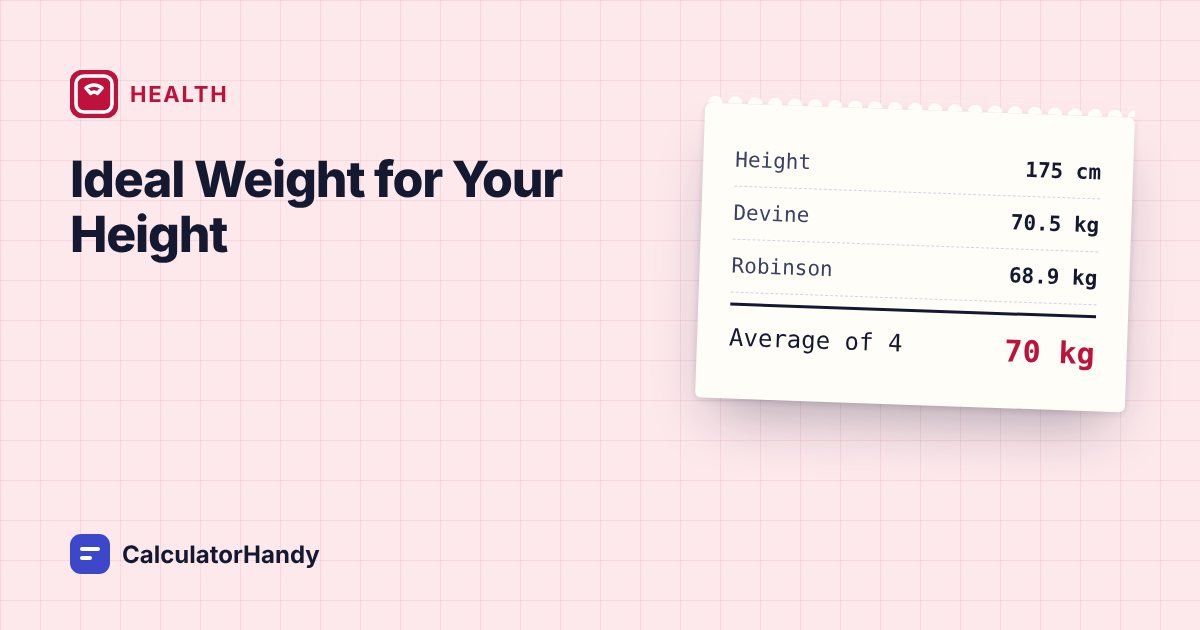
175 cm is 68.9 inches, which is 8.9 inches above 5 feet.
- Devine: 50 + 2.3 × 8.9 = 70.5 kg
- Robinson: 68.9 kg
- Miller: 68.7 kg
- Hamwi: 72 kg
The average is about 70 kg. The healthy BMI range for the same height (18.5 to 24.9) runs from 56.7 to 76.3 kg, which is far wider than the spread between formulas.
Example: a woman who is 160 cm tall
160 cm is 63 inches, 3 inches above 5 feet.
- Devine: 45.5 + 2.3 × 3 = 52.4 kg
- Robinson: 54.1 kg
- Miller: 57.2 kg
- Hamwi: 52.1 kg
Average: about 53.9 kg. The healthy BMI range for 160 cm is 47.4 to 63.7 kg.
What the formulas ignore
- Body frame. Someone with broad shoulders and heavy bones can be lean at a weight a formula calls high.
- Muscle. Muscle is denser than fat. Athletes often weigh “too much” by every formula.
- Age. Research suggests slightly higher weights may be protective in older adults.
- Ethnicity. Health risks for many Asian adults begin at lower weights, which is why Indian guidelines use lower BMI cut-offs.
A better way to use these numbers
Treat the formulas as the middle of a range, then check two other things: your BMI and your waist. A waist above about 90 cm for men or 80 cm for women is linked with higher health risk in Asian populations, whatever the scales say. The BMI Calculator and the Body Fat Estimator add that context.
If you want to change your weight, set a target range rather than a single number, and talk to a doctor or registered dietitian if you have a medical condition.
Frequently asked questions
Which ideal weight formula is the most accurate?
None is accurate for everyone. They were built for different purposes and populations. Using the average of several, together with a healthy BMI range and waist size, gives a more balanced picture.
Do these formulas work for short or very tall people?
They are least reliable at the extremes. Below about 152 cm (5 ft) some formulas give results that are too low, so use the BMI range instead.
Should I aim for exactly my ideal weight?
No. A range is healthier and more realistic than a single number. Many people are healthy several kilos above or below a formula’s figure.