Home
How Your Electricity Bill Is Calculated: Units, Slabs and Charges
Understand your electricity bill: what a unit is, how slab tariffs work, fixed charges and duty, with a worked 320-unit example and tips to cut the bill.
An electricity bill packs a lot onto one page: meter readings, units, slabs, fixed charges, duties and taxes. Once you see how the parts fit together, you can check your own bill in a couple of minutes and spot which part actually changed when it goes up.
Step 1: units consumed
Your meter measures energy in kilowatt-hours, called units. Units used = current reading − previous reading. To estimate an appliance’s use: watts ÷ 1,000 × hours used.
- A 1.5-ton AC drawing about 1,500 W for 8 hours: 1.5 × 8 = 12 units a day
- A 60 W ceiling fan for 12 hours: 0.06 × 12 = 0.72 units a day
- A 10 W LED bulb for 6 hours: 0.06 units a day
The AC alone can use more than everything else in the house put together.
Step 2: the energy charge with slabs
Most Indian discoms use slab (telescopic) tariffs for homes: the first units are cheap and later units cost more. The rates below are only an example; yours will differ by state.
| Slab | Rate | Units in slab | Charge |
|---|---|---|---|
| 0–100 | ₹4.50 | 100 | ₹450 |
| 101–200 | ₹6.00 | 100 | ₹600 |
| Above 200 | ₹7.50 | 120 | ₹900 |
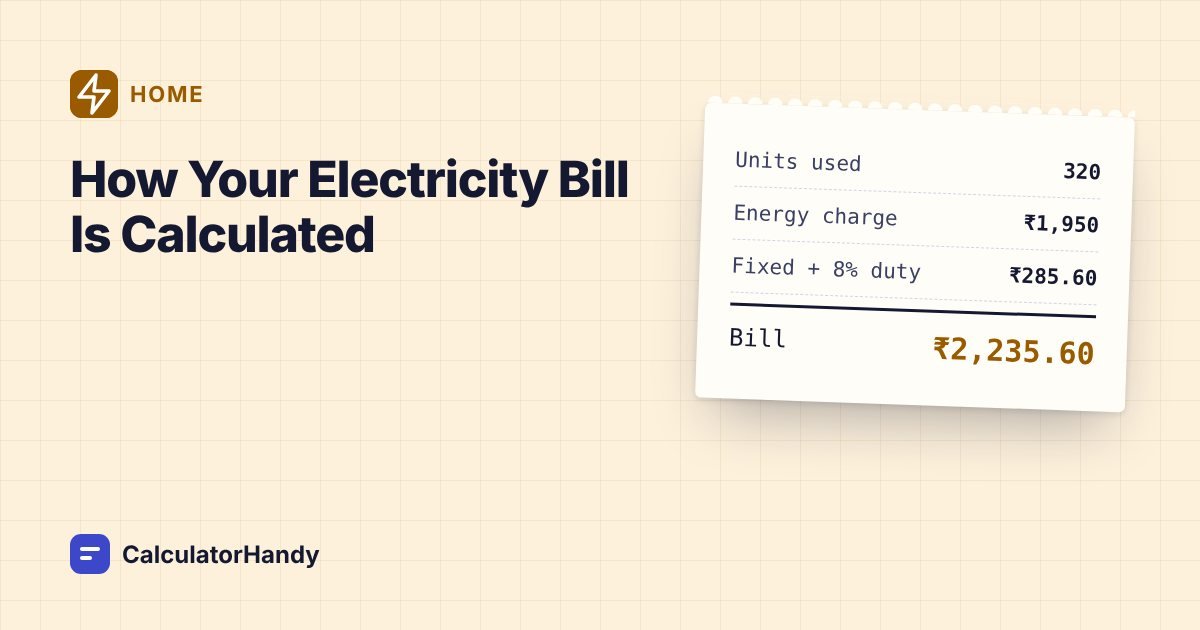
For 320 units, the energy charge is ₹450 + ₹600 + ₹900 = ₹1,950.
Step 3: fixed charge, duty and taxes
On top of energy, bills usually add a fixed charge (linked to your connected load, in this example ₹120) and electricity duty or other taxes as a percentage. With 8% on ₹2,070, that is ₹165.60.
Total: ₹1,950 + ₹120 + ₹165.60 = ₹2,235.60, an average of about ₹6.99 per unit. If the same 320 units were billed at a flat ₹7 per unit, the total would be ₹2,548.80, so slabs help households that use less.
Why one extra appliance hurts more than you expect
Because of slabs, the last units you use are the most expensive. If you are already above 200 units, every extra unit in this example costs ₹7.50 plus duty, not the ₹6.99 average. Running an AC for two more hours a day for a month (about 90 units) would add roughly ₹730 to this bill.
Practical ways to lower the bill
- Set the AC to 24–26°C; each degree lower uses noticeably more power.
- Replace old tube lights and bulbs with LEDs.
- Switch off geysers after use instead of leaving them on standby.
- Look at star ratings when buying fridges and ACs; the running cost over ten years often exceeds the price difference.
- Check that your connected load and tariff category on the bill are correct.
For water charges, the Water Bill Estimator works the same way with your local rates.
Frequently asked questions
What is one unit of electricity?
One unit is one kilowatt-hour (kWh): the energy used by a 1,000-watt appliance running for one hour, or a 100-watt bulb running for ten hours.
Why is my bill higher in summer even though rates did not change?
With slab tariffs, extra units in summer fall into the higher-priced slabs, so the average cost per unit rises along with the number of units.
Where do I find my exact tariff?
Your electricity distribution company (discom) publishes its tariff order, and the rates are usually printed on the bill. Rates differ by state, category and connected load.